
In bulk material handling, the screw conveyor remains one of the most versatile and widely used tools. But not all screw flights are the same. One of the most important, and sometimes overlooked, design details is pitch, the distance between consecutive flights.
Pitch directly affects how much material moves per revolution, how efficiently the screw operates, and how well it handles challenging conditions like inclines, sticky materials, or abrasive loads. At ISC Manufacturing, we custom-engineer flights and augers to match the pitch to your exact process, ensuring smooth flow, longer life, and reliable performance.
Standard Pitch: Industry Standard
A standard pitch screw has flight spacing equal to the screw diameter (e.g., a 12-inch screw has a 12-inch pitch).
-
Best Use: Horizontal or near-horizontal conveying of free-flowing materials like grains, powders, pellets, or aggregates.
-
Advantages: Balanced capacity, energy efficiency, and consistent flow.
-
Limitations: As incline increases above 10°, efficiency drops and slippage becomes a concern.
Short and Half Pitch: Built for Incline and Control
Shorter pitches reduce the volume of material carried per revolution, but improve control and reduce rollback in inclined applications.
-
Half Pitch (½ diameter): Used on steep inclines or vertical screws to keep material packed tightly against the flight.
-
Two-Thirds Pitch: A middle ground often used for moderate inclines or sluggish materials.
-
Advantages: Better material retention, less slippage, more controlled discharge.
-
Limitations: Reduced capacity compared to standard pitch.

Variable Pitch: Smooth Starts and Even Feed
Variable pitch screws are designed with tighter flight spacing at the inlet and progressively wider spacing downstream.
-
Best Use: Under hoppers, bins, or feeders where flooding and surging are a risk.
-
Advantages: Smoothly regulates the inflow of material, reduces surging, and prevents clogs.
-
Limitations: More complex fabrication, higher cost, and potential for uneven wear at pitch transitions.
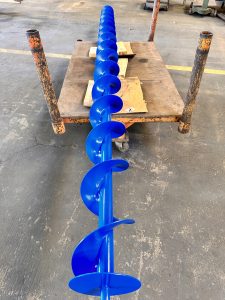

Ribbon Flights: For Sticky or Viscous Materials
Ribbon flights are similar to standard flights but with an open center, leaving a gap between the shaft and the flight.
-
Best Use: Sticky, viscous, or cohesive materials that tend to pack and build up on the shaft.
-
Advantages: Prevents material buildup, promotes cleaner flow, reduces clogging.
-
Applications: Sludges, biomass, and some food processing applications.
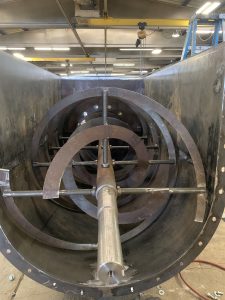

Cut and Cut-and-Fold Flights: Adding Agitation
Cut flights feature notches or slots along the outer edge of the screw. Cut-and-fold designs take it further by folding the cut edges.
-
Best Use: Materials that need aeration, agitation, or mixing during conveying.
-
Advantages: Breaks up compacted material, reduces buildup, and promotes more uniform discharge.
-
Applications: Fertilizer blending, chemical mixing, or light aeration of powders.
The Hidden Factor: Edge Precision and Line Grinding
For sectional flights especially, ISC offers precision line grinding—where the outer edge of the flight is machined down to ensure it runs perfectly true to the shaft.
-
Before Service: A line-ground edge ensures smoother operation, truer diameter, and reduced vibration from the very first revolution.
This is a key advantage of sectional flights that competitors rarely highlight—and one more way ISC extends the lifespan of your equipment.
Why Pitch Choice Matters
Selecting the wrong pitch can cause:
-
Material rollback or clogging in inclined screws.
-
Surging or uneven feed at hoppers.
-
Excess wear at hanger bearings and trough liners.
-
Reduced throughput and higher energy costs.
At ISC, we design screws with pitch matched to the material, incline, capacity, and environment—ensuring optimal performance and fewer maintenance headaches.
ISC Builds It Right
Whether you need a standard screw for horizontal duty, a half-pitch auger for steep inclines, a variable-pitch feeder under a bin, or a specialty ribbon or cut flight for sticky or mixing applications, ISC delivers flighting and augers engineered to last.
We fabricate:
-
Standard, short, half, and variable pitch screws.
-
Ribbon, cut, cut-and-fold, and paddle flights.
-
Shafted and shaftless designs.
-
AR400/500, Hardox, and stainless steel for abrasive or corrosive service.
-
Precision line-ground sectional flights for smoother, longer performance.
With decades of experience across industries from cement to food processing, we know that pitch is more than just geometry—it’s the key to keeping your material moving efficiently.
📞 Need help choosing the right pitch for your process? Contact ISC today for expert guidance and custom-built flighting.
🌐 www.iscmfg.com


